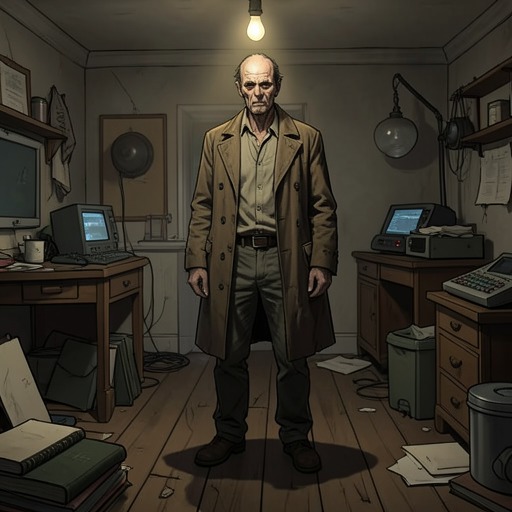
Pavel Ivanovich Chichikov (c2aaadc1)
Dead SoulsPavel Ivanovich Chichikov is the novel’s deliberately chosen rascal: a man whose disciplined ambition, polished manners, and talent for adapting to institutions turn the buying of dead serfs into a bid for wealth. His defining motive takes shape in childhood, when his father teaches him to save every kopeck and treat useful connections as more dependable than friendship. Across the episodes of his career, that lesson becomes both a practical method and a moral trap: it propels him toward imagined prosperity, but ends with his dispatch-box and its deeds confiscated and himself confined in prison.
Identity and Background
Chichikov’s beginnings are modest and obscure, despite his parents’ status as members of the gentry. A female relative, seeing him as a newborn, remarks that he has turned out unlike his parents and resembles a chance passer-by. The narrator frames his earliest life as if seen through a dim, frost-encrusted window: he grows up in a tiny room with small windows that are never opened, beside an invalid father who paces in a lambskin-lined dressing gown, his foot bandaged, continually sighing and spitting into a sandbox. The child’s routine is copying lessons, ink on his lips and fingers, and the discomfort of having his ear twisted when he strays from the copybook.
The copybook teaches him to tell no lies, obey superiors, and cherish virtue. His father’s practical instructions, however, give that moral language a more calculating companion. When the father takes him to stay with a relative in the county town and attend a local school, he leaves him a few coppers and a compact set of rules: study and please the teachers; avoid too much company, but cultivate richer classmates if companionship proves useful; let others provide the hospitality; and, above all, save every kopeck. The father argues that friends may desert a person in adversity, whereas money will not fail him. Chichikov never sees his father again, but the injunctions sink deep into him.
From Thrift to Ambition
The adult Chichikov is not simply a miser who loves money for its own sake. He saves because he imagines what money can buy: carriages, an elegant house, and refined dinners. The sight of a wealthy man in a handsome drozhki makes him stop and contemplate the life represented by such display. Even after school, he takes no holiday, eager to enter government service; although praised in his diploma, he has difficulty obtaining a nomination and begins in a minor post paying only thirty or forty roubles a year.
He answers this low position with extraordinary self-denial and persistence. From early morning until late at night, he copies official documents, sometimes sleeping on tables in the government building and eating with the watchman, while managing to remain neat, cheerful, and careful in his bearing. His habits show the same combination that defines him later: bodily discipline in the service of advancement, and attention to appearances even in an unpromising situation. His ambition is not a sudden turn toward wealth but a long apprenticeship in patience, economy, and reading the needs of those who control access to it.
The Dead-Soul Scheme
A commission involving several hundred peasants from a ruined estate gives Chichikov a decisive insight into how official categories might be used for private gain. The estate has been brought low by cattle disease, bad bailiffs, failed harvests, epidemics, and the owner’s own extravagance. Chichikov, acting as an attorney, must arrange the peasants’ transfer to the Public Trustee and explain that some have died. The secretary’s casual response—that another soul will be born to replace one who dies, provided the dead person remains on the revision lists—leads Chichikov to see an opening in the gap between recorded status and actual life.
He imagines buying dead peasants before a new revision list is made, then presenting them as settlers to be transferred to land in Taurida or Kherson. He calculates that the Council of Public Trust might pay two hundred roubles for each and that the scheme could produce a capital of two hundred thousand roubles. The incentive is clear to him: landowners burdened with poll-tax payments might gladly surrender dead names, while he could claim to be moving the peasants to land available cheaply on condition that it be colonized. He plans to give the supposed settlement a name derived from his own, and even imagines supplying official confirmation through a letter from the Khersonian rural police superintendent—which, in his plan, would be himself. The scheme turns the bureaucratic fiction of a living name on a revision list into a speculative asset.
Adaptability and New Prospects
When Chichikov reappears at the estate of Andrei Ivanovich Tientietnikov, adversity has left visible marks. His frockcoat is shabby, and his carriage, coachman, valet, horses, and harness all look second-hand; his finances are evidently strained. Yet the signs of careful self-presentation endure: his old breeding and refined expression remain, his manners have grown more assured, and a spotless collar and dickey set off his clean-shaven face. The contrast between worn possessions and immaculate appearance shows how he preserves social polish even as his material position declines.
He also approaches his business more cautiously than before. Seeing that Tientietnikov is absorbed in reading and philosophical conversation, Chichikov decides not to begin with his host. Instead, he quietly questions the household servants and learns that Tientietnikov once visited a neighboring general, whose daughter had been involved with him before they separated. Chichikov’s first move is thus not open persuasion but information-gathering: he studies the household’s relationships to discover how his errand might be advanced. The pattern that served him in government life remains active in the new setting.
At another estate, the Colonel’s elaborate ideas about dressing Russian peasants in German clothes as a means of advancing science and trade do not draw Chichikov into the discussion. He says that such matters are not his concern: his business is to acquire a few souls and have the purchase confirmed. The response sharply separates the Colonel’s grand reforming talk from Chichikov’s immediate objective. Faced with an unfamiliar institutional setting, he reduces the conversation to the transaction he has come to secure.
The visit to Konstantin Theodorovich Kostanzhoglo nevertheless opens a prospect beyond fictitious property. Chichikov listens to advice about energetic estate management, personal oversight, learning the work thoroughly, knowing the peasants, limiting superfluities, and devoting oneself to husbandry. He imagines mortgaging the dead souls to establish a real estate, then organizing its labor so that every part of the enterprise supports the others and even waste yields income. For the first time, he respects a man not merely for rank or wealth but for practical intelligence, and he pictures himself following Kostanzhoglo’s example.
That new aspiration immediately takes financial form. Chichikov plans to buy Khlobuev’s estate, using the ten thousand roubles already at his disposal and seeking another fifteen thousand from Kostanzhoglo; for the balance, he considers mortgaging the estate or making Khlobuev wait and forcing him to seek payment through the courts. The imagined change from buying fictitious souls to managing a genuine property is therefore real but incomplete: Chichikov still frames enterprise through borrowing, leverage, and pressure on a seller.
Arrest and Narrative Significance
Before he can pursue that estate, Chichikov’s cultivated appearance becomes the backdrop to a sudden reversal. Just as he has dressed himself in a fashionable suit and is admiring its effect in the mirror, a gendarme arrives with orders that he present himself to the Governor-General. He is taken directly to the official residence, where the Prince tells him that the woman he induced to witness a will has been arrested and that he will be confronted with her. Chichikov gasps that he is guilty but claims that rascals led him astray; the Prince rejects the excuse, cites a record of felonies, and orders him sent to prison pending trial. His fine clothes sharpen the contrast between his carefully staged respectability and the crimes laid against him.
In his cell, the contrast becomes material. Chichikov is placed in a damp, mouldy room with a barred window, an unvarnished table, two poor chairs, and a broken stove that lets smoke through its cracks but gives no heat. He has not been allowed to bring even necessities, and his dispatch-box, containing the deeds to the dead souls and the rest of his gains, remains in an official’s hands. As he rolls on the floor, remorse takes hold; he fears that another twenty-four hours of the misery will leave no Chichikov alive. Murazov’s arrival an hour after Chichikov reaches the prison brings immediate relief, marking a new opening at the moment his accumulated schemes have collapsed.
The narrator’s choice to make a rascal the hero is explicit: after rejecting the overused, exhausted figure of the “man of worth,” the narrator insists that it is time to yoke a rascal to the shafts. Chichikov gives that choice its satirical force. His conduct is neither merely spontaneous greed nor a simple love of hoarding; it develops from an early lesson in money’s reliability, a long practice of self-discipline, and a sharp eye for opportunities hidden in social and administrative arrangements. Even his proposed turn toward productive estate management does not erase the habits of calculation that shaped his earlier fraud. His arrest exposes the cost of those habits, while the prison scene leaves his moral change unresolved: remorse has entered, but the episode closes with Murazov’s arrival rather than with a settled account of what Chichikov will become.